



Bangladesh Garment Workers’ Current Protest: What to Expect and a Few Questions to Examine
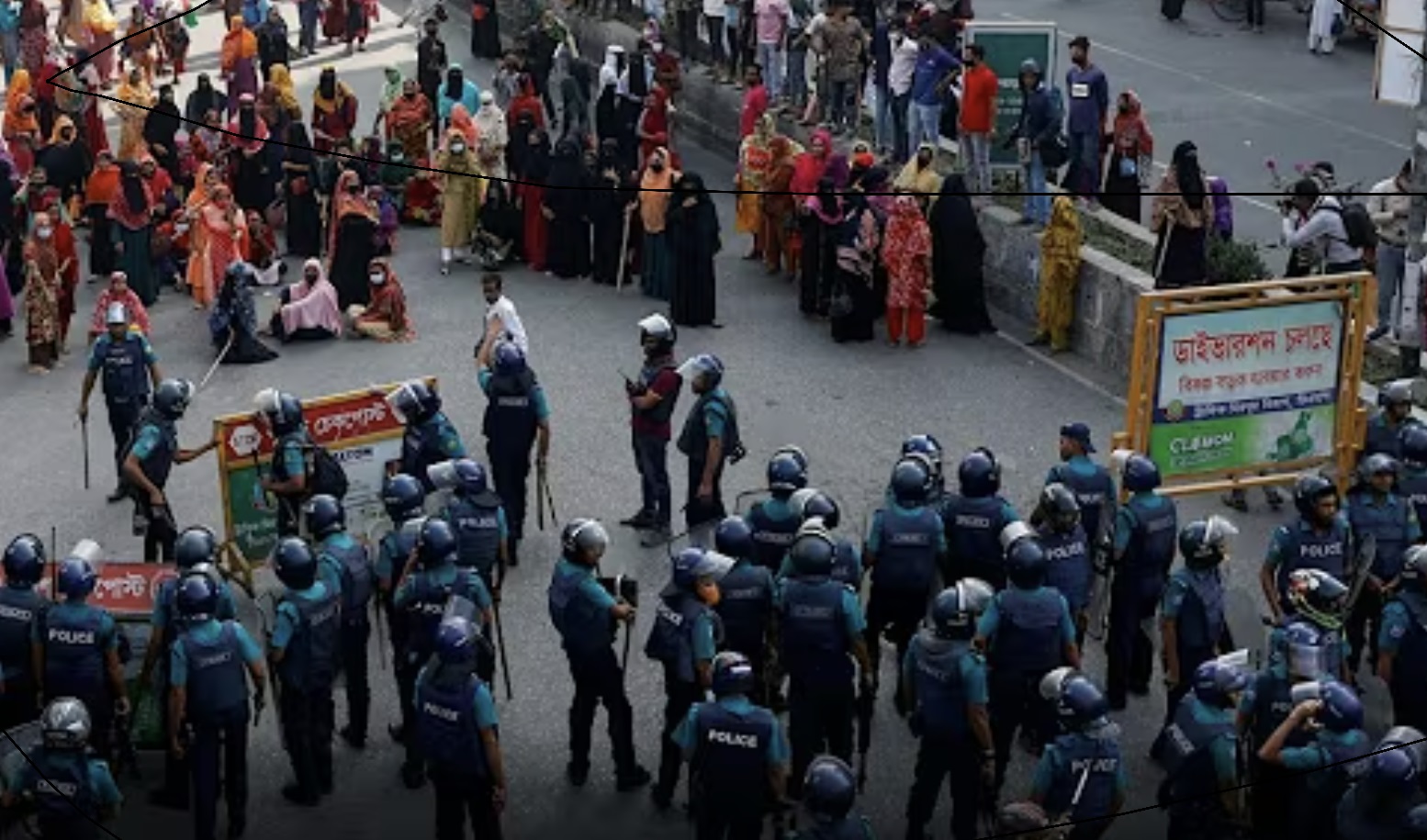
The Garment industry is at the centre of Bangladesh’s foreign exchange earnings, contributing 40 billion USD annually. Yet workers’ minimum wage barely meets basic living conditions. Chowdhury examines one of the largest industrial workers’ protests in recent history, driven by demands for wage adjustments.
Garment workers, thousands in number, across several cities and industrial areas in Bangladesh have risen in fierce protests from Saturday, October 31, 2026, through November 6, 2026. Their demands in the earlier protests in October and the seven-day protests include minimum wage increase proportionate to other increases and in accordance with prior agreement regarding wage adjustment, and distribution of a certain part of profit among the workers that never reaches them despite being mandatory under the law. Their demand for the minimum wage is around 240 USD monthly, with their current wage on average half of their on-going demand.[1]
It should be mentioned that Bangladesh’s annual inflation rate increased to 8.34 per cent in September. Living costs have also increased and the middle class is squeezed out of financial stability. The Bangladesh Bureau of Statistics (BBS), the state-operated statistical organ, states: the annual inflation rate in September 2026, picked up from a ten-month low of 8.26% in the previous month to 8.34% marking its highest level since June.[2] Prices spiked at a quicker rate across most sub-sectors, especially food and non-alcoholic beverages (7.22% vs 7.02% in August); housing and utilities (9.81% vs 9.44%); and transport (9.46% vs 9.41%). Inflation also jumped for clothing and footwear (10.31% vs 9.94%); health (3.73% vs 3.48%); transportation (7.76% vs 7.75%); recreation and culture (9.54% vs 9.30%); education (7.51% vs 7.34); and restaurants and hotels (13.26% vs 12.49%).[3] All these are part of the necessary value workers get to keep their body and soul together so that they can enter through the factory gates to turn wheels/operate machines while the surplus value they produce and are appropriated by the owners remains huge. The owners’ luxury is not the only meterstick to measure the height of appropriated surplus value. As luxury is a very small part of the appropriated surplus value. The real size lies in accumulation of capital.
The workers’ rage has been on display over the last few weeks. As a general rule to workers’ protests, police action and repression was also going on. In terms of participation, rage, length of protest, as media reports said, the current garments workers’ protest is one of the biggest protests by industrial workers in recent-Bangladesh history.
The Garment Industry
Bangladesh, the second largest global garments exporter, generates around 40 billion USD annually. Only China precedes Bangladesh in terms of garment export. The industry is Bangladesh’s mainstay of export-earning – accounting for 80 percent of the Bangladesh merchandise export, and contributing to about 10 per cent to the GDP.[4]
The number of workers employed in the garments industry, as different data show, is about 4 million. This number changes depending on factories closed down, factories down- or up-scaling number of workers due to cancellation of or increase in orders, availability of electricity, political disturbance, etc. At the same time, it should not be missed that the industry “supports 15 million people through direct jobs and wider supply chain work while garment exports reach $46 billion. The workforce is young and female driven, with 85% of workers [are] women and 60% [of the workers are] aged [between] 15 to 24 [years]. Employment gains sit beside wage pressure, since 60% of [the] workers earn below the minimum wage and 40% report overtime without pay.”[5] One can consider or compare the conditions of 15 million working souls in relation to a population in a European city rich with resources.
The garment factory owners include Bangladeshi and foreign individuals and companies. Most of these factories are owned by individuals/families while many are operated as a company. Many of the factories are clustered in a number of areas around the capital city of Dhaka and the port-city of Chattogram [earlier spelled as Chittagong] in the south-eastern corner of the country. Many factories are in a number of Export Processing Zones, which enjoy certain facilities. The Bangladesh state does not operate any of the garment factories.
The garments’ factory owners form a strong lobby because of the weight of the sector’s export-earning. Their main organization is the Bangladesh Garments Manufactures’ and Exporters’ Association (BGMEA), which has a general membership of 4,309.[6] It should not be misunderstood that this is the only organization of the owners, as there are also other associations of producers of other types of garments, and that is the Bangladesh Knitwear Manufacturers and Exporters Association (BKMEA).
Citing data from different sources,[7] AB Rahman writes that it is difficult to ascertain the exact number of garment factories in Bangladesh, as it depends on the method one uses in counting the number. The methods include a number of “association members, operational export factories, or every small subcontracting unit.”[8] AB Rahman adds other than the garments factories registered as member of the BGMEA, “of which about 3,500 have been counted as operational in recent years”, there are “thousands of smaller cut-make-trim and subcontracting units that are not the [BGMEA] members, so the true total — including informal workshops — is higher and not precisely tracked.”
Other investigations found that there are thousands of small-sized sub-contracting and manufacturing units that produce for the larger factories. Many of these small units operate with two to five to seven to ten sewing machines; and the number of workers in these types of factories vary from 5 to 10, 20 and 30. So, the exact number of the garment factories, irrespective of size and operational procedure, is larger than the official number reported.
The general trend of the garment factory owners is to have a good relationship with the government. However, there are mainly two factions among the entire chunk of owners, as observed informally and through mainstream media reports since inception of this industry in Bangladesh; and each of these two is closer to two dominating political parties: Awami League and Bangladesh Nationalist Party. The closeness to government helps get easier and bigger help from the state machine including subsidiary, bank loan, and incentives. In all the legislative assembly elections, a number of the garments factory owners till now have secured nomination from all the dominating political parties, a number of them get elected, and a few also secured ministerial posts in the cabinet/council of ministers.
Interestingly, many garment factory owners, as informally claimed by contending parties, finance a number of unions or give money to a number of union leaders. But, it is not possible to get documentary evidence of such deals other than observing the lifestyle/living standard of a number of union leaders.
Garment Workers Action and Political Influences
The protests compelled hundreds of garment factory owners to close down factories. The number of closed down garments factories vary, as different news media reports differently. It ranges from 500 to 700. A few reports even cited the figure 1,000[9] On all these issues – number of protesting garment workers, number of garment factories closed, number of members of law enforcement agencies, number of wounded and dead workers, number of wounded law enforcement agency members – it is difficult to get the exact number. However, the number of places workers organized protests is well-reported in Bangladesh’s media.
The state machine has had to mobilize thousands of members in the law enforcement agencies. It also created a noncoercive arm in the form of a wage board.
The protests began in the last days of October, and it spilled over to later days. The same was the area of protests – initially from one or two places to at least half a dozen places; and these are the places garments factories are concentrated.
The protesting workers blocked roads and highways as part of their protests, which led to scores of miles of traffic jams. The blockades later transformed into clashes with law enforcement, and reported vandalization of a number of transports. The rage and the force the protesting workers showed are near to unparalleled. The closure of the garment factories has affected at least a million workers. At the same time, there is apprehension that shipment of finished products to destinations would be disrupted.
As a response, already late, to the workers’ demand, the government has constituted a wage board. The move is forcing workers to enter into a lengthy process, while they are already struggling in the market of essentials. There is no doubt that: 1) the state machine would be compelled to concede parts of a few demands of the workers, 2) a few demands will go buried within bureaucracy files and tricky negotiation processes, and 3) the workers will have to wait for an opportune moment to again raise unrealized, but long due and long-promised demands, and this rage of protest will diffuse unless profound class struggles are engaged with revolutionary theory.
The protests have erupted while the country’s economy as a whole is facing a very hard time, which has roots within the national economy and politics – squabbles between factions and sub-factions of the dominant interests – and in the current world reality where wars and sanctions hamper and stifle many aspects of the economy.
The protests have also raised a number of questions that range from initiators or organizers of the protests, its relation to national politics and to factions of the dominating interests, to issues related to competing countries and interests. The protests occurred in the backdrop of factions and sub-factions of the dominating interests entanglement in a fierce fight following the political developments since August 2024, though imperialism has been playing a determining role longer than 2024. One faction of the dominating interests accuses the other of fomenting protests to gain political leverage over the other and, thus, it has been connected by a faction to the on-going political contention to national level politics. There is also a question of non-governmental organizations’ role of support and funding to groups active among the workers. This question goes beyond the national frontier of Bangladesh and reaches to the metropolis of the global imperialist order, which show two aspects: competing capitals’ role, and weakness of genuine workers’ union and workers’ leadership with workers’ program.
The protest, however, shows that it is not only an economic program; it is also a political program. The undecided question is: who is playing against whom in national politics and in the international market? It would be wrong to consider the protest as a conscious rebellion of the workers. A number of unions with questionable connections are playing a role while a number of unions with more politicized programs are going silent in these protest days and on the workers’ demand. The unions going silent also have a certain political position following their mother party, which has a certain position on political questions at the national level.
The question of class-aware unions, politicization of the workers, rise of class-conscious union leadership, and workers getting free from the clutches of the unions with dubious connections are yet to be resolved. These questions are not even on the table of discussion of unions claiming to be Red. It should not be missed that idealists and extreme Rightists political elements have already infiltrated the ranks of the workers with different types of material aids. They never raise the questions of class, class struggles, class politics, exploitation, or private property. The unions claiming to be Red have no literature countering the Rightist/Idealist unions. It is almost impossible to find related political literature for the workers – an essential material to organize a real workers’ movement armed with class politics, and organized effort to politically educate the workers effectively other than a few drab and hollow slogans. This broader perspective – Rightists’ role and the so-called Red’s inactivity – influences, and will influence the current garment workers’ protest and its trajectory.
Farooque Chowdhury writes from Dhaka, Bangladesh. His most recent book is titled With the Passing Time (NGG Books, Dhaka, 2021). His other books include The Great October Revolution (NGG Books, Dhaka, Bangladesh, 2022) and Micro Credit: Myth Manufactured [ed.] (Shrabon Prokashani, Dhaka, Bangladesh, 2007). His books in Baanglaa are on the history of labor movement and Venezuela.
Endnotes
[2]BBS, Bangladesh Bank, the central Bank of the country. (https://www.bb.org.bd/en/index.php/econdata/inflation
[3] Coloma, C. J. (2026, November 10). Bangladesh inflation rate eases in October. Trading Economics. https://tradingeconomics.com/bangladesh/inflation-cpi/news/599823
[4] Miah, Mohammad & Khan, Ayub. (2026). Diversification is Bangladesh RMG’s Next Imperative. 6. pp 35-36.
[5]Reinhardt, Thomas. Bangladesh Garment Industry Statistics”, in Worldmetrics REPORT 2026, published: February 12, 2026, updated: June 29, 2026, https://worldmetrics.org/bangladesh-garment-industry-statistics/
[6]BGMEA, General Members. See https://www.bgmea.com.bd/page/member-list
[7]BGMEA — general member list, NYU Stern Center — assessing the true size of Bangladesh's garment industry, NYU Stern Center for Business and Human Rights — Beyond the Tip of the Iceberg: Bangladesh's Forgotten Apparel Workers (report, December 2015), Textile industry in Bangladesh — Wikipedia (overview & figures) and the WTO — world textiles & clothing trade statistics,
[8] AB Rahman. July 3, 2026 (updated on October 5). "How Many Garment Factories Are in Bangladesh?” Collective Studio. https://collectivestudioltd.com/journal/how-many-garment-factories-in-bangladesh
[9]I am not referencing mainstream media, rather information gathered from social media and independent YouTube reporters.