



Book Review: One Love: Essays on Pan African Struggles Here and There, Presented to Horace Campbell. Edited by Michael O. West & David Johnson. Africa World Press, 2027
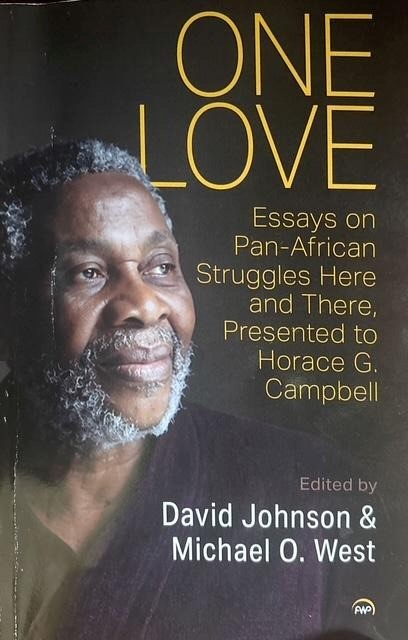
One Love is a must-read for peoples across all walks of life in the Global African family and beyond. Nigel Westmaas invites readers to read the collection that honours the Mwalimu while reflecting on the intellectual and political worlds he helped shape.
While attending a symposium in Syracuse to mark the 25th anniversary of the 2001 Durban World conference against Racism, Racial Discrimination and Xenophobia, Makini (Roy-Campbell) proudly showed me a book, whose striking front cover with black background and bearing Horace Campbell’s reflective and forward-looking portrait and the words One Love immediately caught my attention. While listening to the speakers at the forum, I thumbed through it and found it difficult to put down. Here was an edited collection honoring someone I know and admire, yet its pages offered fresh perspectives on his life, scholarship, and activism. The pleasure of recognition offered by the editors was accompanied by new angles on the movements, people, and thought that demonstrated Campbell was always an activist, a Pan Africanist, a teacher and intellectual whose concerns have always extended beyond the university. He was the man who first introduced me to the concepts of ubuntu and African fractals. These encounters with Mwalimu Campbell, now documented in a text, remain memorable because they opened new ways of thinking about humanity, knowledge and the world around us. Reading this collection brought back some of that experience, a sense of being invited to reconsider what one thought was already understood.
Tribute volumes mostly face particular challenges. Affection for its subject can produce warm recollections without necessarily deepening our understanding of the subject or the historical circumstances that shaped them. But what impressed me about One Love was how often its contributors moved beyond salutation to interpretation and insight.
Edited by two friends of Mwalimu Campbell, Michael O West and David Johnson, and serious scholars and activists in their own right, the collection benefits from an understanding of the connections between intellectual work and political engagement. To assess Campbell formally through his publications would leave much of his influence unexplained. The conversations, classrooms, friendships, and movement gatherings matter as well. These are among the places where ideas acquire practical meaning and where one generation encounters another.
The book’s nineteen chapters are organised into four broad thematic sections: Campbell as teacher and mentor; struggles in academies and communities; struggles to bring ideas and practice together; and themes tracing his intellectual and political journey. Taken together, these sections provide a “one love” template for understanding the connections between his teaching, scholarship and activism.
The presence and contributions of former students of Campbell in the text, including Mahder Serekberhan, now a rising scholar in her own right, is especially impactful. Their chapter inclusions invite us to consider a dimension of intellectual life that conventional measures of scholarly achievement often miss. Mwalimu Campbell’s influence travels through other people’s questions, activism, research and commitments to the cause. It might be visible in a published acknowledgment, but it survives better in less formal ways, in a recalled chat, a challenge to an accepted interpretation, or encouragement offered a decisive moment in one of his friends or colleagues’ life. These recollections give substance to the designation “Mwalimu”, making his teaching and activism central to the volume’s account of his wider influence.
A highlight of the volume is Michael West’s masterpiece chapter, “Toward the Second Emancipation: Horace Campbell and the Militant tendency at the Congress of the Black Writers, 1968.” West essentially revisits the famous Montreal gathering in 1968 through Campbell’s participation as a young Black power militant. West is concurrently analytical, witty and informative about the ins and outs, the incomes and the outcomes of the conference with lead players who were or became the famous names of the pan African activists and central figures. Memorable notes or fillers pepper West’s chapter, including his well-known description of “imperialist intelligence services as unintended archivists of Black (and other radical) liberation struggles.” The phrase captures a bitter historical irony whereby institutions and repressive apparatuses seeking to monitor and contain liberation movements or radical activity sometimes preserved evidence that later became useful in reconstructing these movements, individual presence and activities of activists. West also made this observation notably with Jamaica’s own police intelligence in a monograph that assessed its monitoring of Walter Rodney in the 1960s.
Of course, given that these archives are shaped by surveillance and the state’s priorities, they demand critical reading.
West’s description of Steve Biko as the “most consummate and complete figure in the story of Black Power globally” is also an arresting comment. It challenges readers to reconsider the geography through which Black Power is commonly understood. Biko’s observation that “all new ideas get undue publicity in the United States, a land of marketers” sharpens the point.
Another chapter of the book, written by Patricia Daley, assesses Mwalimu Horace’s critique of the patriarchal model in Zimbabwe, how he places and addresses questions of power, gender and liberation in a generally reluctant field of enquiry.
Peter Bembir’s very informative chapter engages Campbell’s activism and scholarly input on the import of waterways in the underdevelopment and development of African societies and especially his contribution to understanding the shrinking of Lake Chad and related environmental, social and political consequences.
Other chapters focus on Campbell’s stirring opposition to the Obama- Clinton attack on Libya. His colleagues and friends likewise explore his courage, his unrelenting pursuit of ubuntu and other radical projects, conferences, meetings, his persistence, and his courage.
Walter Bgoya follows Campbell’s intellectual and activist sojourn in Tanzania, while Pat Rodney pays tribute to this close comrade and friend of her husband, Walter Rodney.
Mario Nisbett, a visiting scholar at Syracuse likewise draws attention to Campbell’s Pan African “emancipatory practices,” a formulation that captures the collection’s recurring concern with the relationship between ideas and action. David Austin, whose own work had made an important contribution text on the 1968 Montreal conference, pens a tribute to Campbell in the volume.
The appendices extend the volume’s usefulness. An almost complete listing of Campbell’s main publications provides a valuable resource for readers who want to follow the development of his scholarship. Appendix two closes imaginatively and appropriately on an activist note, documenting Campbell’s 45-point affidavit in support of a dreadlocked woman in a case before Jamaica’s supreme court in 2019
The dedication of the book to Makini Roy-Campbell, described by the editors as “comrade, coworker, partner of the honoree,” deserves the accolade. It acknowledges the shared work and relationships that sustain a public intellectual life.
My first encounter with this book began with a cover and a familiar face. The collection honours the Mwalimu while inviting reflection on the intellectual and political worlds he helped shape. This is a fitting tribute to Horace Campbell, or “Sule,” as he was known to David Johnson, one of the editors and a longtime friend who knows him well.
One Love opens new ways of thinking and leaves questions to pursue. In honouring Horace Campbell, the book invites its readers to carry that spirit of inquiry and solidarity into the unfinished work of emancipation. Solidarity must be practiced among people whose experiences and priorities do not always coincide. A life committed to Pan Africanism, like Mwalimu, must therefore be assessed through the work of sustaining relationships as well as through declarations of common solidarity and purpose. This is achieved in One Love.
Nigel Westmaas is a professor of Africana Studies at Hamilton College, New York. He is the author of A Political Glossary of Guyana (2021). He has made substantial contributions to various scholarly publications, including a chapter in the book Black Power in the Post-Independence Anglophone Caribbean (2014), and The Fire that Time: Transnational Black Radicalism and the Sir George Williams Occupation with his analysis titled "Musings on Walter Rodney, the Black Power movement, and Race and Class in Guyana” (2022). Westmaas's research interests include the history of the newspaper press, Pan-Africanism, and the rise and impact of political and social movements, primarily in the Anglophone Caribbean.